
Bullying Prevention
Conflict resolution and bullying prevention are natural partners. A comprehensive violence prevention plan should include both. Schools that have a solid conflict resolution program in place are ideally positioned to engage in bullying prevention as a next step. Conflict resolution teaches students how to solve problems when power is fairly equal and when both parties have some interest in resolving the conflict. Bullying, on the other hand, occurs when one party has more power, that party has no interest in resolving the problem, and he is primarily interested in hurting the other. In these circumstances, conflict resolution techniques are not likely to be effective, so other methods must be in place. (To learning more about bullying prevention, please visit our online learning module.)
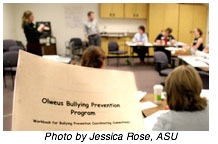 A bullying prevention program should teach students how to distinguish normal peer conflict, which responds well to conflict resolution strategies, from bullying violence, which warrants a different set of strategies. Once students understand which type of conflict they are dealing with, they can decide which strategies to use. There are several factors (for example, contextual factors and personality traits) that determine when some strategies are more appropriate than others.
Rethinking the deeper impacts that bullying has on our school culture is important for existing conflict resolution programs. While many such programs have a long history of creating safe and caring youth cultures and providing students and staff with specific skills to confront injustice, the recent attention to bullying has expanded the importance of this work and has provided language and additional strategies for surfacing and handling this more serious form of conflict and violence. Likewise, bullying prevention programs can benefit from the comprehensive experience that conflict resolution programs offer.
Videos of Possible Interest
- On-the-Spot Bullying Prevention
- Cyberbullying Toolkit: Webinar Archive
- Peaceful School Bus Program – Hazelden Foundation
- Teaching Students How to “Stand Up” to Bullying – Webinar Archive
- Bullied: A Student, a School and a Case That Made History
- Another Bully Busters Song
- Girls Bullying
- Social Emotional Learning via The Heart Story (RCCP)
- The Transformation of West Philadelphia High School: a story of hope
- Puppet Show – Kids Against Bullying
- PAX Good Behaviour Game
- Cyberbullying Toolkit for Educators
- Students Take on Cyberbullying
- Help Increase the Peace Students Bullying Research Project
- Cyberbullying (UNICEF)
- On-the-Spot Mediation: how to use your skills in everyday life
- Overview of the Olweus Bullying Prevention Program
See MORE VIDEOS...
Sample Catalog Resources
Below you'll find a randomized listing of up to 20 related items (we may have more...) drawn from our Resource Catalog.
| Resource Title | Description | Links |
|---|---|---|
| Understanding bullying within the camp setting: tips for parents | Pdf document for parents about bullying in the camp setting. | |
| Social and Emotional Learning and Bullying Prevention | 21-page briefing paper prepared for the National Center for Mental Health Promotion and Youth Violence Prevention by the Collaborative for Academic, Social, and Emotional Learning (CASEL) and the Social and Emotional Learning Research Group at the University of Illinois at Chicago. "Schools using a social and emotional learning (SEL) framework can foster an overall climate of inclusion, warmth, and respect, and promote the development of core social and emotional skills among both students and staff. Because bullying prevention is entirely congruent with SEL, it can be embedded in a school's SEL framework. The aims of this brief are to (a) provide a basic description of a school-wide SEL framework, (b) illustrate the relationship between social and emotional factors and bullying, and (c) explain how an SEL framework can be extended to include bullying prevention." | |
| Bullying behavior chart | Pdf document in table form which outlines three types of bullying, (physical, emotional and social), as well as levels of severity, with behaviors in each section, adapted from, "New Jersey cares about bullying." | |
| Stop Bullying Now Activities Guide | A 12-page pdf of activity ideas for preventing bullying in schools and youth serving organizations. | |
| Intervention tips for law enforcement officers | Pdf document examining the role of law enforcement in bullying. | |
| Children who bully | Pdf document on children who bully. | |
| Working with young people who bully others: tips for mental health professionals | Pdf document with tips for mental health workers who treat bullies. | |
| Clique bullying scenario | Web-based interactive scenario which presents children reacting to a clique bullying situation and "taking a stand against the crowd." | |
| Bullying in out-of-school time programs: tips for youth-serving professionals and volunteers | Pdf document that examines bullying in extracurricular activities with tips for professionals and volunteers. | |
| Bullying prevention and intervention: TeamMates Mentoring Program Lincoln Public Schools | 9-page PDF case study which, "looks at one program in Nebraska, Lincoln Public Schools (LPS) TeamMates, that has decided to address bullying at several schools through mentoring, using volunteers from the community to reach out to bullies and victims alike." | |
| Tug of war - Peace Through Understanding Conflict | This 10-chapter 104-page book, available as a pdf, is for youth ages 8-16 interested in a peaceful world - and in understanding the forces that cause conflict, both in personal relationships and across the globe. Tug of War describes: 1) What the roots of war are. 2) How we create "The Enemy". 3) A new way to handle violence. Illustrated by award-winning artist, Rod Cameron. Part of the Education for Peace Series by Atrium Society Publications | |
| Educational resources: articles, books, films about bullying and teasing | Word document provides list of books, articles and films on bullying and teasing. | |
| HRSA stop bullying now resource kit | One page list of materials on bullying for professionals and parents. | |
| Bullying in our schools: protecting GLBT youth | Powerpoint presentation which discusses bullying in schools particularly involving gay, lesbian, bi-sexual and transgendered youth in schools. | |
| What we know about bullying | Pdf document with information on bullying. | |
| Involvement of law enforcement officers in bullying prevention | Pdf document examining ways in which law enforcement personnel can be involved in the prevention of bullying. | |
| Physical and verbal bullying | Web-based interative scenario which explores bullying. | |
| Steps to address bullying at your school: tips for school administrators | Pdf document with advice to school administrators on addressing bullying at school. | |
| How to intervene to stop bullying: tips for on-the-spot intervention at school | Pdf document with instruction on dealing with bullying at school, how to intervene and follow-up procedures. | |
| What can students and youth do to lend a hand | Pdf document with advice to students and youth on bullying prevention. |